<?xml version="1.0" encoding="UTF-8"?>
<rss version="2.0"
	xmlns:content="http://purl.org/rss/1.0/modules/content/"
	xmlns:wfw="http://wellformedweb.org/CommentAPI/"
	xmlns:dc="http://purl.org/dc/elements/1.1/"
	xmlns:atom="http://www.w3.org/2005/Atom"
	xmlns:sy="http://purl.org/rss/1.0/modules/syndication/"
	xmlns:slash="http://purl.org/rss/1.0/modules/slash/"
	>

<channel>
	<title>Real Estate Investment Blog by RealData &#187; real estate partnership</title>
	<atom:link href="http://realdata.com/blog/tag/real-estate-partnership/feed/" rel="self" type="application/rss+xml" />
	<link>http://realdata.com/blog</link>
	<description>Analysis, technology, resources and more</description>
	<lastBuildDate>Mon, 14 May 2012 20:48:12 +0000</lastBuildDate>
	<language>en</language>
	<sy:updatePeriod>hourly</sy:updatePeriod>
	<sy:updateFrequency>1</sy:updateFrequency>
	<generator>http://wordpress.org/?v=3.3.2</generator>
		<item>
		<title>Ten Commandments for Real Estate Investors: Commandment #9</title>
		<link>http://realdata.com/blog/ten-commandments-for-real-estate-investors-commandment-9/?utm_source=rss&#038;utm_medium=rss&#038;utm_campaign=ten-commandments-for-real-estate-investors-commandment-9</link>
		<comments>http://realdata.com/blog/ten-commandments-for-real-estate-investors-commandment-9/#comments</comments>
		<pubDate>Sun, 13 May 2012 22:12:20 +0000</pubDate>
		<dc:creator>Frank Gallinelli</dc:creator>
				<category><![CDATA[articles]]></category>
		<category><![CDATA[real estate education]]></category>
		<category><![CDATA[Uncategorized]]></category>
		<category><![CDATA[commercial real estate]]></category>
		<category><![CDATA[real estate investing]]></category>
		<category><![CDATA[real estate investment]]></category>
		<category><![CDATA[real estate investment analysis]]></category>
		<category><![CDATA[real estate investors]]></category>
		<category><![CDATA[real estate partnership]]></category>
		<category><![CDATA[RealData]]></category>

		<guid isPermaLink="false">http://realdata.com/blog/?p=1037</guid>
		<description><![CDATA[Commandment #9:  Thou shalt not expect something for nothing. “There is no such thing as a free lunch.” “If it looks too good to be true…, etc.” You have heard these truisms many times. I’ve reserved a place of honor &#8230; <a href="http://realdata.com/blog/ten-commandments-for-real-estate-investors-commandment-9/">Continue reading <span class="meta-nav">&#8594;</span></a>]]></description>
			<content:encoded><![CDATA[<p><strong>Commandment #9:  Thou shalt not expect something for nothing.</strong></p>
<p>“There is no such thing as a free lunch.” “If it looks too good to be true…, etc.”</p>
<p>You have heard these truisms many times. I’ve reserved a place of honor for them in my upcoming “Encyclopedia of Clichés.” Just because something is a well-worn bromide, however, doesn’t mean it isn’t true, and sometimes we can look right past its importance because we assume it should be obvious.</p>
<p>Our rational selves all recognize that virtually everything has a cost, even things that are free.  “Call now for our free report about investing in gold! (or about mortgage modification or crabgrass prevention).” Translation: Give us your telephone number so we can hound you relentlessly until you buy something from us.</p>
<p>When a guy in a brightly colored checkered sport jacket tells you something is free or involves no obligation, you suspect immediately that you are being scammed. It is when the “great deal” is dressed up more subtly that you may miss what’s really at work.</p>
<p>I’ve seen such illusory great deals cloud the minds of investors, and I talk about this in my grad school classes in real estate investment analysis. One example that I use is the case of a seller who is providing extremely generous owner financing: very low rate with interest-only for an extended period. Should you assume that he’s doing this because he likes you? If not, then you ought to be looking for what element of self-interest is motivating him and whether or not you are paying for his generosity in some other way.</p>
<p>Perhaps the low initial debt service will improve your cash flow as a prospective new owner, and the seller expects that benefit to serve as a smoke screen of sorts, inducing you to look more kindly on what is actually an inflated purchase price. As a side benefit to him, maybe he is also thinking that he will shift some of his overall profit from what he would get by charging higher interest on the financing, taxed at ordinary income rates, to capital gain taxed (at least as I write this) at a lower rate.</p>
<p>In short, you need to look behind the “great deal” and work your way deeper into its implications for you as the investor. Will you really have an acceptable long-term return? If a life emergency forced you to re-sell this property soon, would a new buyer who requires financing on more conventional terms be willing to pay as much as you just did?</p>
<p>Or perhaps the deeper meaning in this example is simply that the owner is offering these terms because he <em>really</em> has to sell this building as quickly as possible. Can you use that insight to your advantage and negotiate to get the attractive financing as well as a lower price? Get the worm but not the hook?</p>
<p>Another example I use in my classes concerns a commercial property that has a vacancy in one of its six retail spaces. To offset your reluctance to buy, the seller makes this proposition: “I will guarantee the rent for that space for a full year at $x per square foot. Run your numbers and you will see that my asking price makes good sense and provides you with an excellent return.” (an aside: $x/sf is at the high end of reasonable rent for that space.)</p>
<p>It sounds good. Maybe too good, and that’s when your alarm bells need to clang. You pause for breath, think a bit harder, and then realize that another way of looking at this is that the seller has effectively offered you a price reduction equal to the amount of one year’s rent for that space. You need to ask yourself if that concession materially changes the risk associated with this deal.  Does this disguised price reduction compensate you adequately for the risk you&#8217;re assuming? Can you eventually rent the space for $x dollars?  Has there been a problem getting or keeping tenants in the past, either for this space or for the entire property? Is this proposition a creative solution to a temporary vacancy, or is the seller trying to kick the proverbial can down the road and leave you to figure out what to do about this property’s chronic vacancy?</p>
<p>The  <em>could</em> be a creative solution to a short-term problem, or it could be smoke and mirrors to hide a long-term difficulty. If this offer is nothing more than a price reduction, then perhaps you would choose to forget about rent guarantees and prefer instead to negotiate your own idea of an appropriate lower price, one that is more in concert with the actual degree of risk you see in this property.</p>
<p>So what is the takeaway from our ninth and penultimate commandment? In real estate dealmaking, there is seldom, if ever, anything offered that doesn’t have a cost of some sort, or a string attached. Your job is to identify that cost, follow that string. It’s not necessarily the case that anything underhanded is going on, although there may be a fine line at times between smart negotiating and subterfuge; but, in any case, you need to look beyond the outward appearance of what’s being offered and try to discover the motive behind it.</p>
<p>Ulterior, or otherwise.</p>
<p><em>A Postscript</em> – (Can a post have a postscript?)</p>
<p>Before you conclude that I am a jaundiced, suspicious, disagreeable curmudgeon (and despite the fact that your conclusion strays not far from the truth), let me suggest that perhaps not every open hand portends a slap in the face. In an industry that is predominantly a zero-sum game, there are still those who are willing to be helpful without sending an invoice. I am of course not talking about the snake-oil salesmen and pay-to-play mentors I complained of in Commandment #6, but rather about those experienced investors and other real estate professionals who will actually – and willingly – share some of their expertise.</p>
<p>Several times in my posts and newsletters I’ve mentioned the forums at <a href="http://www.biggerpockets.com">BiggerPockets.com</a> as an example of this sort of knowledge exchange done right. (FYI, I have no financial or other inside interest in BP. Just a fan.) It works because it’s essentially a non-commercialized, pay-it-forward culture. I’ll answer your question, and someone else with a different specialization will answer mine.</p>
<p>There is a cost – there is always a cost – but in this case I believe it’s simply the implied obligation to be helpful if you’ve been helped. Pretty low-impact in an industry otherwise infested with high-priced, low-value gurus. And maybe some meaningful business will percolate up from the bottom of all this socialization. Just don’t let Groucho Marx join. As he famously remarked, “I don’t care to belong to any club that will have me as a member.”</p>
<p><small><em>Come back soon for Commandment #10</em></small></p>
<p><small>Previously: <a href="http://realdata.com/blog/ten-commandments-for-real-estate-investors-commandment-8/" target="_blank">Ten Commandments for Real Estate Investors: Commandment #8</a></small></p>
<p><small>(c) Copyright 2012 Frank Gallinelli All Rights Reserved<br />
All content in this blog is provided for entertainment and informational purposes only and with the understanding that the writers are not engaged in rendering, legal, professional, financial or investment advice. The owner of this blog makes no representations as to the accuracy or completeness of any information on this site or found by following any link on this site.</small></p>
]]></content:encoded>
			<wfw:commentRss>http://realdata.com/blog/ten-commandments-for-real-estate-investors-commandment-9/feed/</wfw:commentRss>
		<slash:comments>0</slash:comments>
		</item>
		<item>
		<title>Ten Commandments for Real Estate Investors:  Commandment #2</title>
		<link>http://realdata.com/blog/ten-commandments-for-real-estate-investors-commandment-2/?utm_source=rss&#038;utm_medium=rss&#038;utm_campaign=ten-commandments-for-real-estate-investors-commandment-2</link>
		<comments>http://realdata.com/blog/ten-commandments-for-real-estate-investors-commandment-2/#comments</comments>
		<pubDate>Thu, 05 Apr 2012 16:52:19 +0000</pubDate>
		<dc:creator>Frank Gallinelli</dc:creator>
				<category><![CDATA[articles]]></category>
		<category><![CDATA[real estate education]]></category>
		<category><![CDATA[Uncategorized]]></category>
		<category><![CDATA[cash flow]]></category>
		<category><![CDATA[Debt coverage ratio]]></category>
		<category><![CDATA[Net Operating Income]]></category>
		<category><![CDATA[NOI]]></category>
		<category><![CDATA[operating expenses]]></category>
		<category><![CDATA[real estate]]></category>
		<category><![CDATA[real estate investing]]></category>
		<category><![CDATA[real estate investment]]></category>
		<category><![CDATA[real estate investment analysis]]></category>
		<category><![CDATA[real estate partnership]]></category>

		<guid isPermaLink="false">http://realdata.com/blog/?p=806</guid>
		<description><![CDATA[...our second commandment addresses an issue that is essential for all investors: Clarity.  The need for clarity is important not only in regard to your own personal objectives, but also in how you communicate with other parties in a transaction. <a href="http://realdata.com/blog/ten-commandments-for-real-estate-investors-commandment-2/">Continue reading <span class="meta-nav">&#8594;</span></a>]]></description>
			<content:encoded><![CDATA[<p><strong>Commandment #2: </strong><strong>Thou shalt be clear.</strong></p>
<p>&#8220;I want to make something perfectly clear.&#8221;</p>
<p>How many times have you heard someone say that? Parents say it, trying to get a message past their kids&#8217; MP3 players.  Politicians say it, signalling the impending arrival of a dense, rolling smoke screen.  Real estate investors ought to say it much more, and mean it.</p>
<p>And so our second commandment addresses an issue that is essential for all investors: Clarity.  The need for clarity is important not only in regard to your own personal objectives, but also in how you communicate with other parties in a transaction. I invite you to read a <a href="http://realdata.com/blog/for-real-estate-investors-a-lesson-in-clarity/" target="_blank">longer article</a> that I’ve written on this subject, but for now, just some high points:</p>
<p>When you analyze an investment opportunity, you usually do so first to decide if you want to go forward and, if so, on what terms.  You need to be clear about your overall investment objectives (more about that in another “commandment”) so that you’ll have some rational basis for a decision.  Do you have a rate-of-return target, a required cash flow, a goal for growth in value?</p>
<p>Presumably, you’ll do some sort of financial analysis to get to that decision, and if you choose to go forward with the deal, your next task may very well be to “sell” your point of view to a third party. You need to be clear about your objective here as well so that you can tailor your presentation to be appropriate for your intended audience. Are you trying to convince the seller that your offer is reasonable? Trying to make your case with a lender to provide the financing? Looking to attract an equity partner to invest along with you?</p>
<p>Different parties will want to focus on different issues. For example, if your purpose is to get financing, you want to be sure that your presentation clearly shows items that a lender wants to see – for example, Debt Coverage Ratio and cash flow. If you’re soliciting an equity partner, it’s essential that you can demonstrate not only that the property makes economic sense in general, but also that your proposed allocation of partnership benefits – cash flow, preferred return, sales proceeds – holds out hope of a suitable return for the partner.</p>
<p>When you start to build your case, you need to be clear and precise in your use of terminology. I have often seen the misuse of terms that have very specific meaning to real estate professionals – “operating expense,” “NOI,” and “cap rate” to cite some of the more common examples of scrambled usage. Nothing can ruin your credibility and sink your deal faster than the improper use of terminology.</p>
<p>Finally, your actual presentation – pro forma or other financial workup – also requires clarity. You can’t expect other parties to a transaction to accept your analysis of a deal if you present them with a disorganized jumble of numbers.  Even if you have all the right calculations and all the right data, it’s of little value if your recipient has to go on a scavenger hunt, struggling to find the key information.</p>
<p>Your takeaway here should be this:  You must first be clear about your own personal objectives when you consider a potential investment property. Then, when you decide to move forward, you need to convey your analysis of the deal in terms that are accurate and unambiguous, and that will provide your target audience with exactly the information they need in a format they can understand.  Clarity trumps fog every time.</p>
<p><em>Come back soon for Commandment #3</em></p>
<p>Previously: <a href="http://realdata.com/blog/ten-commandments-for-real-estate-investors-commandment-1/" target="_blank">Commandment #1: Thou Shalt Take Nothing for Granted.</a></p>
<p><small>(c) Copyright 2012 Frank Gallinelli All Rights Reserved<br />
All content in this blog is provided for entertainment and informational purposes only and with the understanding that the writers are not engaged in rendering, legal, professional, financial or investment advice. The owner of this blog makes no representations as to the accuracy or completeness of any information on this site or found by following any link on this site.</small></p>
]]></content:encoded>
			<wfw:commentRss>http://realdata.com/blog/ten-commandments-for-real-estate-investors-commandment-2/feed/</wfw:commentRss>
		<slash:comments>0</slash:comments>
		</item>
		<item>
		<title>Refi Existing Investment Property to Purchase Another?</title>
		<link>http://realdata.com/blog/refi-existing-investment-property-to-purchase-another/?utm_source=rss&#038;utm_medium=rss&#038;utm_campaign=refi-existing-investment-property-to-purchase-another</link>
		<comments>http://realdata.com/blog/refi-existing-investment-property-to-purchase-another/#comments</comments>
		<pubDate>Fri, 04 Nov 2011 20:22:35 +0000</pubDate>
		<dc:creator>Frank Gallinelli</dc:creator>
				<category><![CDATA[articles]]></category>
		<category><![CDATA[real estate education]]></category>
		<category><![CDATA[RealData software]]></category>
		<category><![CDATA[Uncategorized]]></category>
		<category><![CDATA[cash flow]]></category>
		<category><![CDATA[DCR]]></category>
		<category><![CDATA[discounted cash flow]]></category>
		<category><![CDATA[internal rate of return]]></category>
		<category><![CDATA[Net Operating Income]]></category>
		<category><![CDATA[NOI]]></category>
		<category><![CDATA[pro forma]]></category>
		<category><![CDATA[real estate]]></category>
		<category><![CDATA[real estate appraisal]]></category>
		<category><![CDATA[real estate financing]]></category>
		<category><![CDATA[real estate investing]]></category>
		<category><![CDATA[real estate investment]]></category>
		<category><![CDATA[real estate investment analysis]]></category>
		<category><![CDATA[real estate investors]]></category>
		<category><![CDATA[real estate partnership]]></category>
		<category><![CDATA[real estate software]]></category>
		<category><![CDATA[RealData]]></category>

		<guid isPermaLink="false">http://realdata.com/blog/?p=669</guid>
		<description><![CDATA[One of our Facebook fans, Tony Margiotta, posed this question, which I’m happy to try my hand at answering here: “Could you talk about refinancing an income property in order to purchase a second income property? I&#8217;m trying to understand &#8230; <a href="http://realdata.com/blog/refi-existing-investment-property-to-purchase-another/">Continue reading <span class="meta-nav">&#8594;</span></a>]]></description>
			<content:encoded><![CDATA[<p>One of our Facebook fans, Tony Margiotta, posed this question, which I’m happy to try my hand at answering here:</p>
<p>“Could you talk about refinancing an income property in order to purchase a second income property? I&#8217;m trying to understand the refinance process and how you can use it to your advantage in order to build a real estate portfolio. Thanks Frank!”</p>
<p>=============================================================</p>
<p><strong>The Good News</strong></p>
<p>Your plan – to extract some of the equity from an investment property you already own and use that cash as down payment to purchase another – is fundamentally sound. In fact, that’s exactly what I did when I started investing back in the ‘70s, so to me at least, it seems like a brilliant idea.</p>
<p>Of course, you need to have enough equity in your current property. How much is enough? That will depend on the Loan-to-Value Ratio required by your lender. The refi loan has to be small enough to satisfy the LTV required on the current property, but big enough to give you sufficient cash to use as the down payment on the new property.</p>
<p>For example, let’s say your bank will loan 70% of the value of your strip shopping center, which is appraised at $1 million. So, you expect to obtain a $700,000 mortgage. Your current loan is $550,000, which would leave you with $150,000 to use as a down payment on another property.</p>
<p>Given the same 70% LTV, $150,000 would be a sufficient down payment for a $500,000 property, i.e. 70% of $500,000 = $350,000 mortgage plus $150,000 cash.</p>
<p><strong>But Wait… Some Issues and Considerations</strong></p>
<p>Unfortunately, it’s not the ’70s or even ’07 anymore, so while the plan is sound, the execution may present a few challenges. Best to be prepared, so here are some issues to consider:</p>
<ul>
<ul>
<li>In the current lending environment, financing can be hard to find, and the terms may be more restrictive than what you experienced in the past. Notice that I used a 70% LTV in the example above. You might even encounter 60-65% today, while a few years ago it could have been 75-80%.  In order to obtain the loan, you might also have to show a higher Debt Coverage Ratio than you would have in the past – perhaps 1.25 or higher, compared to the 1.20 that was common before.</li>
</ul>
</ul>
<ul>
<ul>
<li>How long have you had the mortgage on the current property?  Some lenders will not let you refinance if the mortgage isn’t “seasoned” for a year or even longer.</li>
</ul>
</ul>
<ul>
<ul>
<li>How long have you owned the property? A track record of stable or growing NOIs over time will support your request for a new loan.  You need to make a clear and effective presentation to the lender showing that the refi makes sense, especially in a tight lending environment.</li>
</ul>
</ul>
<ul>
<ul>
<li>You need to run your numbers and not take anything for granted. For example, will your current property have a cash flow sufficient to cover the increased debt?</li>
</ul>
</ul>
<ul>
<ul>
<li>Keep in mind that you’re adding more debt to the first property, so the return on the new property has to be strong enough to justify the diminution of the return on the first.</li>
</ul>
</ul>
<ul>
<ul>
<li>Have you compared the overall return you would achieve from the two properties using the refi plan as opposed to the return you might get if you brought in some equity partners to help you buy the new property?</li>
</ul>
</ul>
<p>
In a nutshell, refinancing an existing income property to purchase another is a time-honored and proven technique, but it in a challenging lending environment be certain you do your due diligence and run your numbers with care.</p>
<p>Of course I never miss an opportunity to promote <a href="http://www.realdata.com" target="_blank">my company’s software</a>, so consider using that not only to analyze the deal and its variations, but also to build the presentations that will optimize your chances of obtaining the financing and/or the equity investors.</p>
<p>Frank Gallinelli</p>
]]></content:encoded>
			<wfw:commentRss>http://realdata.com/blog/refi-existing-investment-property-to-purchase-another/feed/</wfw:commentRss>
		<slash:comments>8</slash:comments>
		</item>
		<item>
		<title>5 Mistakes Every Real Estate Investor Should Avoid</title>
		<link>http://realdata.com/blog/5-mistakes-every-real-estate-investor-should-avoid/?utm_source=rss&#038;utm_medium=rss&#038;utm_campaign=5-mistakes-every-real-estate-investor-should-avoid</link>
		<comments>http://realdata.com/blog/5-mistakes-every-real-estate-investor-should-avoid/#comments</comments>
		<pubDate>Fri, 21 Oct 2011 18:20:35 +0000</pubDate>
		<dc:creator>Frank Gallinelli</dc:creator>
				<category><![CDATA[articles]]></category>
		<category><![CDATA[real estate education]]></category>
		<category><![CDATA[RealData software]]></category>
		<category><![CDATA[Uncategorized]]></category>
		<category><![CDATA[capitalization rate]]></category>
		<category><![CDATA[cash flow]]></category>
		<category><![CDATA[discounted cash flow]]></category>
		<category><![CDATA[internal rate of return]]></category>
		<category><![CDATA[IRR]]></category>
		<category><![CDATA[Net Operating Income]]></category>
		<category><![CDATA[NOI]]></category>
		<category><![CDATA[pro forma]]></category>
		<category><![CDATA[real estate financing]]></category>
		<category><![CDATA[real estate investing]]></category>
		<category><![CDATA[real estate investment]]></category>
		<category><![CDATA[real estate investment analysis]]></category>
		<category><![CDATA[real estate investors]]></category>
		<category><![CDATA[real estate partnership]]></category>
		<category><![CDATA[real estate software]]></category>
		<category><![CDATA[RealData]]></category>

		<guid isPermaLink="false">http://realdata.com/blog/?p=635</guid>
		<description><![CDATA[In my nearly 30 years of providing analysis software to real estate investors, and almost a decade of writing books and teaching real estate finance at Columbia University, I’ve had the opportunity to talk with thousands of people who were &#8230; <a href="http://realdata.com/blog/5-mistakes-every-real-estate-investor-should-avoid/">Continue reading <span class="meta-nav">&#8594;</span></a>]]></description>
			<content:encoded><![CDATA[<p>In my nearly 30 years of providing analysis software to real estate investors, and almost a decade of writing books and teaching real estate finance at Columbia University, I’ve had the opportunity to talk with thousands of people who were analyzing potential real estate investments. Some of these people were seasoned professionals, many were beginners or students, but just about all were highly motivated to analyze their deals to gain the maximum advantage.</p>
<p>I’ve seen some tremendous creativity in their analyses, but I’ve also seen some huge missteps. Here are some of the pitfalls you will want to be sure to avoid.</p>
<p><strong><br />
1. The Formula That Doesn’t Compute</strong></p>
<p>If you are attempting any kind of financial analysis, then a full-featured spreadsheet program like Excel is almost certainly your tool of choice. You might opt for professionally built models, like my company’s <a href="http://www.realdata.com" target="_blank">RealData software</a>, or you could attempt to construct your own.</p>
<ul>
<li>One of the most common problems I see in do-it-yourself models is the basic formula error. A robust financial analysis involves the interaction of many elements, and it is really easy to make any of several errors that are hard to detect. The simplest of these is an incorrect reference.  You entered your purchase price in cell C12 and meant to refer to it in a formula, but you typed C11 in that formula by mistake. You may (or perhaps may not) notice that your evaluation of the property doesn’t look right, but it can be difficult for you to find the source of the problem.</li>
</ul>
<ul>
<li>You used to have a formula in a particular cell, but you accidentally overwrote that formula by typing a number in its place. The calculation is gone from the current analysis, and if you re-use the model, you’ll always be using that number you typed in, not the calculated value you expect.</li>
</ul>
<ul>
<li>Cutting and pasting numbers seems innocent enough, but it can scramble your model&#8217;s logic by displacing references. Simple rule: Never cut and paste in a spreadsheet.</li>
</ul>
<ul>
<li>Perhaps the most insidious is the formula that doesn’t do what you thought it did. Let’s say you have three values that you enter in cells A1, B1, and C1. You want to write a formula that adds the first two numbers and divides the result by the third. It’s easy to say this in plain English: “I want A1 plus B1, divided by C1.” So you write the formula as <strong>=A1+B1/C1</strong>. Wrong. Division and multiplication take precedence, so the division happens first and that result gets added to A1. Not what you expected. The formula that does what you intended would be <strong>=(A1+B1)/C1</strong>, where the sum of A1 and B1 is treated as a single value, divided by C1.</li>
</ul>
<p><strong><br />
2. The Modern Art Syndrome</strong></p>
<p>Even if you get all of your formulas correct, your job is only half done. I harangue my grad students constantly with this pearl of wisdom: Sometimes you create a pro forma analysis of a property strictly for your own interest. You will never show it to anyone else. Most of the time, however, successful completion of a real estate investment deal means you have to “sell” your point of view to one or more third parties:</p>
<ul>
<li>You may be the buyer, trying to convince the seller that your offer is reasonable;</li>
</ul>
<ul>
<li>You may need to convince the lender that the deal should be financed; or</li>
</ul>
<ul>
<li>You may need to show an equity partner that his or her participation would be profitable.</li>
</ul>
<p>Most of the homebrew presentations that I see look to me like a Jackson Pollock painting with numbers superimposed. The layout usually has a logic that I can’t discern, and I find myself hunting for the key pieces of information that the presenter should have designed to jump off the page.</p>
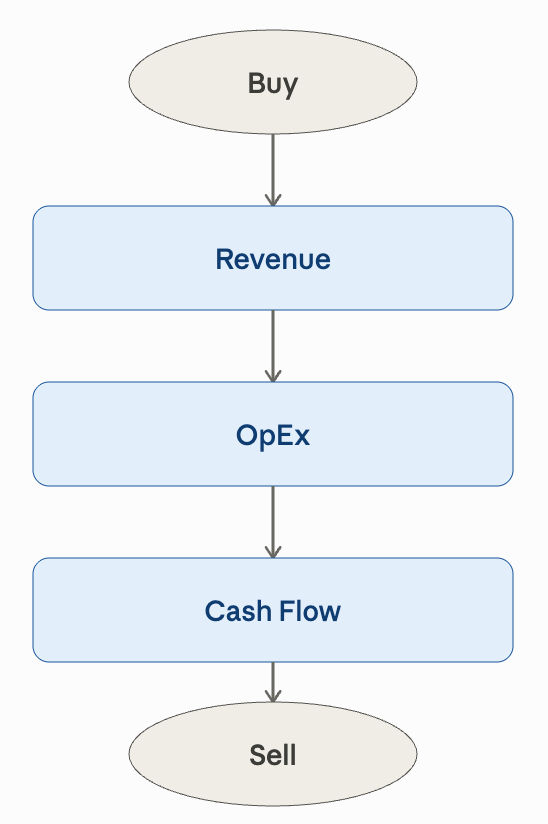
<p>The layout needs to be orderly and logical: revenue before expenses and both before debt service.</p>
<p>Labels need to be unambiguous:</p>
<ul>
<li>If you mention capital expenditures, are they actual costs or reserves for replacement?</li>
</ul>
<ul>
<li>Is the debt service amortized or interest only?</li>
</ul>
<ul>
<li>When you label a number as “Price,” are you talking about the stated asking price, or your presumed offer? Be clear.</li>
</ul>
<p>Lenders and experienced equity investors will be looking for several key pieces of information before they scrutinize the entire pro forma, items like Net Operating Income, Debt Coverage Ratio, Cash Flow and Internal Rate of Return.  If these items don’t stand out, or if the presentation is disorganized, you might as well add a cover page that says, “ I’m Just an Amateur Who Probably Can’t Pull This Deal Off.”</p>
<p><strong><br />
3. Errors, We Get Errors, Stack and Stacks of Errors</strong></p>
<p>You may be too young to know Perry Como’s theme song (by the way, it was “letters,” not “errors”), but the tune goes through my head when I look at some investors’ spreadsheets.</p>
<ul>
<li>The #NUM error can appear when you try to perform a mathematically impossible calculation, like division by zero, or also when attempting an IRR calculation that can’t resolve.</li>
</ul>
<ul>
<li>#VALUE usually occurs when you type something non-numeric (and that can include a blank space, letters, punctuation, etc.) into a numeric data-entry cell. If there are formulas in your model that are trying to perform some kind of math using the contents of that cell, those formulas will fail. In other words, if you try to multiply a number times a plain-text word, you’re violating a law of nature and Excel is going to call down a serious punishment on your head, a sort of high-tech scarlet letter.</li>
</ul>
<p>It can get really ugly really fast because every calculation that refers to the cell with the first #NUM or #VALUE will also display the error message, so the problem tends to cascade throughout the entire model. Unfortunately, I often see investors who then go right ahead and print out their reports with these errors displayed and deliver the reports to clients or lenders.</p>
<p>Your objective in giving a report to a third party is typically to try to convince the recipient to accept your point of view. You will not accomplish that if your report has uncorrected errors.</p>
<p><strong><br />
4. What’s Wrong with This Picture?</strong></p>
<p>It’s the errors you overlook – the ones that don’t have nice, big, upper-case alerts like #VALUE – that can cause the greatest mischief of all; and these can be troublesome even if the analysis is for your eyes only.</p>
<p>It may be an unwanted and unintended side effect of the computer age that we tend to accept calculated reports at face value. Be honest: How often do you sit at a restaurant with a calculator and verify the addition on your dinner check?</p>
<p>This presumption of accuracy can be dangerous when you are evaluating a big-ticket item like a potential real estate investment. As I discussed earlier, you could have bogus formulas that give you inaccurate results. But even if you use a professionally created tool like RealData’s <em>Real Estate Investment Analysis</em> software, you are still not immune to the classic “garbage in, garbage out” syndrome.</p>
<p>The mistake that I see far too often is a failure to apply common sense. For example:</p>
<ul>
<li>“Gee, this investment looks like it will have a 175% Internal Rate of Return. Looks good to me.”  (Reality: You entered the purchase price as $1,000,000 instead of $10,000,000. You should have been saying to yourself, 175% can’t be right; what did I do wrong?)</li>
</ul>
<ul>
<li>“Wow, this property shows a terrific cash flow.” (Reality: You entered the mortgage interest rate as 0.07% instead of 7%.) Again, results outside the norm, either much better or much worse than you would reasonably expect, are your tip-off that a mistake is lurking somewhere. It is essential that you develop the habit of examining every financial work-up – those you create, and also those that are presented to you – very closely to see if the calculations appear reasonable.</li>
</ul>
<p><strong><br />
5. What You Don’t Know CAN Hurt You</strong></p>
<p>The final item in our list of big-time mistakes goes beyond the mechanics of spreadsheets and formulas and into the realm of fundamentals. You can be the most proficient creator of spreadsheet models on the planet, but if you don’t really understand the essential financial concepts that underlie real estate investment analysis, then you will neither be able to create nor interpret an analysis of such property.</p>
<p>The examples that I’ve seen are numerous – I can’t possibly list more than a few here – but they all revolve around the same issue:  A lack of understanding of basic financial concepts as they apply to real estate.  Some of the most important:</p>
<ul>
<li><em>Net Operating Income</em> – This is a key real estate metric, and calculating it incorrectly can play havoc with your estimation of a property’s value. Basically, NOI is Gross Operating Income less the sum of all operating expenses, but I have frequently seen all kinds of things subtracted when they should not be. These have included mortgage interest or the entire annual debt service, depreciation, loan points, closing costs, capital improvements, reserves for replacement, and leasing commissions. None of these items belongs in the NOI calculation.</li>
</ul>
<ul>
<li><em>Cash flow</em> – I have seen NOI incorrectly labeled as “cash flow,” and have seen cash flow miscalculated with depreciation, a non-cash item, subtracted.</li>
</ul>
<ul>
<li><em>Capitalization rate</em> – Cap rate is another key real estate metric and is the ratio of NOI to value. Unfortunately, I’ve encountered some folks who have used cash flow instead of NOI when attempting to figure the cap rate and have ended up with a completely erroneous result – not only for the cap rate itself, but then also for the value of the property.</li>
</ul>
<p>Clearly, there are two vital problems with these kinds of basic errors. First, is that they completely derail any meaningful analysis. If your NOI is not really the correct NOI and your cap rate is not really the correct cap rate, then nothing else about your evaluation of the property can possibly be correct. And second, if you give this misinformation to a well-informed investor or lender, your credibility will evaporate.</p>
<p><strong><br />
The Bottom Line</strong></p>
<p>What is our take-away from these five disasters waiting to happen? You could avoid many of these errors by using the best, professionally developed analysis models – but then, of course, you would expect me to say that because that’s what we do for a living.</p>
<p>Let me suggest three other important steps you can take:</p>
<ul>
<li>Understand that there is no substitute for careful scrutiny of any financial presentation, whether it is someone else’s or your own. Be diligent always and  apply the test of reasonableness.</li>
</ul>
<ul>
<li>Recognize that any real estate analysis you create is likely to be a representation to a third party of the quality of your thinking and professional competence. You wouldn’t be careless or casual with a resume; you should give the same care to your real estate presentations.</li>
</ul>
<ul>
<li>Finally, recognize that you need to make a commitment to mastering the fundamental concepts and vocabulary of real estate investing. There is no substitute for knowledge.</li>
</ul>
<p align="center">####</p>
<p><strong>Want to learn more?</strong></p>
<ul>
<li>Read <a href="http://www.amazon.com/Estate-Investor-Flow-Financial-Measures/dp/0071603271/dp/0071603271/" target="_blank"><em>What Every Real Estate Investor Needs to Know About Cash Flow&#8230; and 36 Other Key Financial Measures</em></a>  and <a href="http://www.amazon.com/Estate-Investor-Flow-Financial-Measures/dp/0071603271" target="_blank"><em>Mastering Real Estate Investment</em></a></li>
</ul>
<ul>
<li>Visit the “Learn” page at <a href="http://www.realdata.com/learn.shtml" target="_blank">www.realdata.com</a></li>
</ul>
<ul>
<li>Finally, check out <a href="http://www.realdata.com/products.shtml" target="_blank">RealData’s real estate investment and development analysis software</a>.</li>
</ul>
]]></content:encoded>
			<wfw:commentRss>http://realdata.com/blog/5-mistakes-every-real-estate-investor-should-avoid/feed/</wfw:commentRss>
		<slash:comments>5</slash:comments>
		</item>
		<item>
		<title>For Real Estate Investors: A Lesson in Clarity</title>
		<link>http://realdata.com/blog/for-real-estate-investors-a-lesson-in-clarity/?utm_source=rss&#038;utm_medium=rss&#038;utm_campaign=for-real-estate-investors-a-lesson-in-clarity</link>
		<comments>http://realdata.com/blog/for-real-estate-investors-a-lesson-in-clarity/#comments</comments>
		<pubDate>Wed, 14 Sep 2011 18:03:40 +0000</pubDate>
		<dc:creator>Frank Gallinelli</dc:creator>
				<category><![CDATA[articles]]></category>
		<category><![CDATA[books]]></category>
		<category><![CDATA[real estate education]]></category>
		<category><![CDATA[RealData software]]></category>
		<category><![CDATA[Uncategorized]]></category>
		<category><![CDATA[capitalization rate]]></category>
		<category><![CDATA[cash flow]]></category>
		<category><![CDATA[NOI]]></category>
		<category><![CDATA[real estate]]></category>
		<category><![CDATA[real estate investing]]></category>
		<category><![CDATA[real estate investment analysis]]></category>
		<category><![CDATA[real estate investors]]></category>
		<category><![CDATA[real estate partnership]]></category>
		<category><![CDATA[real estate software]]></category>
		<category><![CDATA[RealData]]></category>

		<guid isPermaLink="false">http://realdata.com/blog/?p=577</guid>
		<description><![CDATA[Recently, I was conducting the last class in my course on real estate investment analysis that I teach in Columbia's MSRED program.  I had assigned my 55 students a series of case studies (much like those in my book, Mastering Real Estate Investment) and told them to build financial pro forms and discuss the reasoning behind their analyses. After reading and commenting all those analyses, I felt there was one overarching theme on which I wanted to focus my final remarks to the troops: The theme was "clarity." <a href="http://realdata.com/blog/for-real-estate-investors-a-lesson-in-clarity/">Continue reading <span class="meta-nav">&#8594;</span></a>]]></description>
			<content:encoded><![CDATA[<p>Recently, I was conducting the last class in my course on real estate investment analysis that I teach in <a href="http://www.arch.columbia.edu/programs/real-estate-development" target="_blank">Columbia&#8217;s MSRED program</a>.  I had assigned my 55 students a series of case studies (much like those in my book, <a href="http://www.amazon.com/Mastering-Real-Estate-Investment-Examples/dp/0981813801/" target="_blank">Mastering Real Estate Investment</a>) and told them to build financial pro forms and discuss the reasoning behind their analyses. After reading and commenting on all those analyses, I felt there was one overarching theme on which I wanted to focus my final remarks to the troops: The theme was &#8220;clarity.&#8221;</p>
<p>Trying to reduce a course to a single word might seem unrealistic (because it is), but I really had more than one angle on the notion of clarity in mind. Even combined, those notions would not replace the real content of a course in investment analysis, but they might express some essential principles that are sine qua non &#8212; &#8220;without which, nothing&#8221; &#8212; for investors.</p>
<p><strong>Be Clear About Your Objectives</strong></p>
<p>Before you fire up your spreadsheet program or sharpen your pencil, you need to be very clear about your objective (or objectives) in analyzing the property. For example:</p>
<ul>
<li>Are you a potential buyer, trying to establish a reasonable offer on a particular property?</li>
<li>Are you seller or broker trying to justify your asking price?</li>
<li>Are you a buyer or broker, trying to demonstrate to a seller that his or her price and terms would not be acceptable to a reasonable and prudent investor?</li>
<li>Are you seeking financing, or refinancing and need to demonstrate to a lender that this loan will meet their underwriting expectations?</li>
<li>Are you assembling a partnership and trying to show potential equity investors that this deal will make economic sense to them?</li>
</ul>
<p>You are not trying to create alternate realities, but you might be harboring more than one objective in a given situation. For example, for your private use you might want to look at a range of possible offers by creating best-case, worst-case and in-between scenarios; but in making a presentation to the seller, you would surely not begin by volunteering what you believe to be the highest price at which the investment might have a chance of success.</p>
<p>In making a presentation to a lender, your focus must be to ensure that your presentation includes items like debt coverage ratio, allowance for possible vacancy, and projected cash flows &#8212; items that will have an immediate impact on an underwriting decision. For equity partners, you want to be sure that you can demonstrate not only that the property itself makes sense, but that the particular investor, considering allocations and preferred return, can expect an acceptable rate of return on cash invested.</p>
<p>You are typically trying either to make a personal decision about a property or to &#8220;sell&#8221; your point of view to a third party. Being clear in your own mind about the purpose of your pro forma allows you to focus on how you analyze the property and what information is of greatest importance to your intended audience.</p>
<p><strong>Be Clear About Your Use of Terminology</strong></p>
<p>Real estate, like most businesses and professions, has its own language &#8211; terms that carry very specific meaning. The misuse of real estate investment terminology can have several possible consequences, all of them bad.</p>
<ul>
<li>You can substantially skew the results of an analysis by not being clear in your understanding of important terms. Some of the more egregious examples I have seen include:</li>
<p></p>
<ul>
<li>Not understanding the real-estate-specific definitions of terms like &#8220;operating expense&#8221; and &#8220;Net Operating Income.&#8221;  I have often seen investors try to include mortgage payments, capital improvements, or reserves for replacement as operating expenses. This mistake can drastically affect your estimate of a property&#8217;s worth.</li>
<p></p>
<li> Not understanding an important term like &#8220;capitalization rate.&#8221; I have seen investors try to estimate value by applying a cap rate to the property&#8217;s cash flow instead of its Net Operating Income. Big mistake.</li>
<p>
</ul>
<li>You can bring a dialog or negotiation to a grinding halt by being unclear and offhand in your use of what should be unambiguous terms.  Yes, &#8220;price&#8221; is a legitimate English word. But if you use it as part of an analysis or presentation, you will leave your reader stumped.  Do you mean the seller&#8217;s asking price, the buyer&#8217;s offered price, the actual closed selling price?  You can tell me that a building has 20,000 square feet, but do you mean usable square feet or rentable square feet?  It makes a difference.</li>
</ul>
<ul>
<li>You can establish your identity as a rank amateur. Nothing will earn you a sandwich board with the word &#8220;newbie&#8221; on it quicker than misusing terms or lapsing into incomprehensibly vague language. Credibility matters &#8212; just ask your lender or your equity partners.  Be clear. Be precise.</li>
</ul>
<p><strong>Be Clear When You Build Your Pro Forma or Presentation</strong></p>
<p>If you insist on being a do-it-yourselfer, and you plan to give your pro forma or presentation to a third party, keep in mind that nothing will unsell your argument faster than a jumbled pile of numbers.  Your information should flow and be segmented in a logical order (e.g., don&#8217;t show someone the income after the expenses, or the debt service after the cash flows). The reader should be able to apprehend the key metrics with a quick scan of the page, then go back and fill in the details. If your report turns  into a scavenger hunt for vital information, then you will fail to deliver your message. No loan, no partner, no deal.</p>
<p>Your success as a real estate investor requires serious number crunching, but it doesn&#8217;t stop there. You must be able to convey your analysis of a property in terms that are unambiguous, accurate, and relevant to your audience. Clarity is what you need.</p>
<p>&#8211;Frank Gallinelli</p>
<p>Get some clarity, as well as accurate calculations and industry-standard reports. Use <a href="http://www.realdata.com/p/reia/reiafamily.shtml" target="_blank">RealData&#8217;s Real Estate Investment Analysis</a>, a market leader for almost 30 years, to run your numbers and create your presentations.</p>
]]></content:encoded>
			<wfw:commentRss>http://realdata.com/blog/for-real-estate-investors-a-lesson-in-clarity/feed/</wfw:commentRss>
		<slash:comments>3</slash:comments>
		</item>
		<item>
		<title>The Flavor of the Month: Apartment Investing</title>
		<link>http://realdata.com/blog/the-flavor-of-the-month-apartment-investing/?utm_source=rss&#038;utm_medium=rss&#038;utm_campaign=the-flavor-of-the-month-apartment-investing</link>
		<comments>http://realdata.com/blog/the-flavor-of-the-month-apartment-investing/#comments</comments>
		<pubDate>Thu, 07 Apr 2011 17:54:48 +0000</pubDate>
		<dc:creator>Frank Gallinelli</dc:creator>
				<category><![CDATA[real estate industry/economy]]></category>
		<category><![CDATA[commercial real estate]]></category>
		<category><![CDATA[real estate financing]]></category>
		<category><![CDATA[real estate investing]]></category>
		<category><![CDATA[real estate investment]]></category>
		<category><![CDATA[real estate investment analysis]]></category>
		<category><![CDATA[real estate partnership]]></category>
		<category><![CDATA[real estate software]]></category>
		<category><![CDATA[RealData]]></category>

		<guid isPermaLink="false">http://realdata.com/blog/?p=564</guid>
		<description><![CDATA[It comes as no surprise to those of us who are a bit long in the tooth: The recent economic environment has been bad for almost everything, but it&#8217;s good for multi-family investment property. When credit flows freely, almost anyone &#8230; <a href="http://realdata.com/blog/the-flavor-of-the-month-apartment-investing/">Continue reading <span class="meta-nav">&#8594;</span></a>]]></description>
			<content:encoded><![CDATA[<p>It comes as no surprise to those of us who are a bit long in the tooth: The recent economic environment has been bad for almost everything, but it&#8217;s good for multi-family investment property.</p>
<p>When credit flows freely, almost anyone who <em>can</em> buy a house <em>will</em> buy a house. (Whether they can pay for it after the closing is of course another matter.) On the other hand, when credit tightens or dries up almost completely, then the subprime prospects are frozen out of the housing market, along with a sizeable group of perfectly responsible borrowers who now find they can&#8217;t clear the considerably elevated qualification standards. It doesn&#8217;t take tremendous insight to realize that most of these people are now candidates for apartment space. Remember Econ 101?  Supply, demand, etc.</p>
<p>If you read the financial press (or <a href="http://twitter.com/fgallinelli" target="_blank">follow our tweets</a>) then you&#8217;ve seen ample evidence lately that apartment properties are hot. The <a href="http://on.wsj.com/e0Q7rP" target="_blank">Wall Street Journal  cites</a> a Marcus and Millichap report stating the the values of apartment buildings rose 16% in 2010 after falling 27% between 2006 and 2009. In that same article, WSJ says that the supply of new apartment buildings is at a two-decade low. There&#8217;s that supply and demand thing again.</p>
<p><a href="http://t.co/8UxTEdV" target="_blank">Reuters  recently reported</a> that apartment vacancies showed a steep drop in the first quarter of 2011. At the same time, <a href="http://t.co/4nlyO0d" target="_blank">Investor&#8217;s Business Daily noted</a> that even the smallest buildings &#8212; those with four units or less &#8212; were in high demand. An advantage here for the small investor is that this kind of property can usually qualify for Fannie- or Freddie-backed financing, and perhaps on even more favorable terms if the investors lives in one of the units.</p>
<p>After a long period when it seemed like investors were in duck-and-cover mode, it&#8217;s good to see this resurgance of activity.</p>
<p>(self-serving footnote: If you&#8217;re doing an apartment deal, be sure to run the numbers first, Either the <a href="http://www.realdata.com/p/express/" target="_blank">Express</a> or <a href="http://www.realdata.com/p/reia/" target="_blank">Professional Edition</a> of <a href="http://www.realdata.com/p/reia/reiafamily.shtml" target="_blank">Real Estate Investment Analysis</a> will do a great job with apartment buildings. If you&#8217;re raising capital from equity partners, then use the <a href="http://www.realdata.com/p/reia/" target="_blank">Pro Ediiton</a> &#8212; it will give you presentations for individual partners.)</p>
]]></content:encoded>
			<wfw:commentRss>http://realdata.com/blog/the-flavor-of-the-month-apartment-investing/feed/</wfw:commentRss>
		<slash:comments>3</slash:comments>
		</item>
		<item>
		<title>Real Estate Partnerships and Preferred Return</title>
		<link>http://realdata.com/blog/real-estate-partnerships-and-preferred-return/?utm_source=rss&#038;utm_medium=rss&#038;utm_campaign=real-estate-partnerships-and-preferred-return</link>
		<comments>http://realdata.com/blog/real-estate-partnerships-and-preferred-return/#comments</comments>
		<pubDate>Fri, 21 May 2010 14:24:24 +0000</pubDate>
		<dc:creator>Frank Gallinelli</dc:creator>
				<category><![CDATA[articles]]></category>
		<category><![CDATA[real estate education]]></category>
		<category><![CDATA[cash flow]]></category>
		<category><![CDATA[commercial real estate]]></category>
		<category><![CDATA[preferred return]]></category>
		<category><![CDATA[real estate]]></category>
		<category><![CDATA[real estate development]]></category>
		<category><![CDATA[real estate investment]]></category>
		<category><![CDATA[real estate investment analysis]]></category>
		<category><![CDATA[real estate investors]]></category>
		<category><![CDATA[real estate partnership]]></category>

		<guid isPermaLink="false">http://realdata.com/blog/?p=508</guid>
		<description><![CDATA[Q. Can you explain more about how preferred return works in a real estate partnership? Does it always have to go only to the limited partner or non-managing partner? A. The first point to make about real estate partnerships – &#8230; <a href="http://realdata.com/blog/real-estate-partnerships-and-preferred-return/">Continue reading <span class="meta-nav">&#8594;</span></a>]]></description>
			<content:encoded><![CDATA[<p><strong>Q. </strong>Can you explain more about how preferred return works in a real estate partnership? Does it always have to go only to the limited partner or non-managing partner?</p>
<p><strong>A.</strong> The first point to make about real estate partnerships – whether limited, general or LLC – is that there is certainly no single, pre-defined structure used by all investors. In fact, you may be hard pressed to find two partnership agreements whose provisions are exactly the same.</p>
<p>Not all partnerships include a preferred return but, in those that do, its purpose is to counterbalance the risk associated with investing capital in the deal. Typically, the investor is promised that he or she will get first crack at the partnership’s profit and receive at least a X% return, to the extent that the partnership generates enough cash to pay it. In most partnership structures, the cash flow is allocated first to return the invested capital to all partners. The preferred return is paid next, before the General Partner or Managing Member receives any profit.</p>
<p>There are some variations as to exactly how the preferred return might be set up. If the partnership does not earn enough in a given year to cover the preferred return, the typical arrangement is to carry the shortfall forward and pay it when cash becomes available. If necessary it is carried forward until the property is sold, at which time the partners receive their accumulated preferred return before the rest of the sale proceeds are divided. Again, that assumes that the sale proceeds are in fact sufficient to pay the preferred return. If not, the limited partners have to settle for whatever cash is available.</p>
<p>The return may also be compounded or non-compounded. In other words, if part or all of the amount due in a given year can’t be paid and has to be carried forward, the amount brought forward may or may not earn an additional return (similar to compound vs. simple interest). The usual method is for it to be non-compounded. Hence the unpaid amount carried forward does not earn an additional return, but remains a static amount until paid.</p>
<p>An alternative but less common approach is to wipe the slate clean each year. If there isn’t enough cash to pay the preferred return, then the partnership pays out whatever cash is available and starts over from zero next year.</p>
<p>Real estate partnerships will typically define percentage splits between General (i.e., managing) and Limited (i.e., non-managing) partners for profit and sales proceeds. These splits do not come into play until the obligation to pay the preferred return has been met.</p>
<p>For example, let’s say that a limited partner invests $100,000. She is promised a 5% preferred return (non-compounded), 90% of cash flow after the return of capital and payment of preferred return, and 70% of sale proceeds. In the first five years, the partnership generates just enough cash to return the invested capital to all partners. Hence, all future cash flows represent profit. The partnership has a $16,000 cash flow the sixth year, a $20,000 cash flow the seventh year and also sells the property at the end of the seventh year with total proceeds of sale of $150,000. Here is what happens:</p>
<p><img src="http://www.realdata.com/images/afreturn.gif" border="0" alt="year 6 and 7 distributions to LP" width="373" height="184" /></p>
<p>The Limited Partner should receive a preferred return of $5,000 per year (5% of her $100,000 investment). By the end of year 6 she hasn’t received any of this return so she is owed $30,000. In the sixth year the partnership cash flow is only $16,000, so that is all she gets; the balance due is carried forward to year 7. In that year the partnership cash flow of $20,000 is sufficient to pay the $14,000 owed from year 6, the $5,000 from year 7 and still leave enough ($1,000) to split 90/10 with the General Partner. Finally, the property is sold at the end of year 7 with $150,000 proceeds to split 70/30 with the General Partner.</p>
<p>Regarding the question, “To whom does the preferred return go?” it is of course possible to structure a partnership so that it goes either to the General or the Limited partner or to Donald Duck if you think that’s a good plan. However, I have never seen a real estate partnership where the return actually went to the General or Managing Partner. The presumed purpose of the preferred return is to encourage non-controlling investors to risk their capital in your project; and that encouragement often takes the form of a conditional promise of a minimum return, the “preferred return.” It seems to me that you would have a difficult time raising money from investors if your underlying message were, “This deal is so shaky that I need full control plus first dibs on the cash flow. If there’s anything left, you can have some.”</p>
<p>Run the numbers, but think beyond them. A good partnership is one where all the parties can enjoy a reasonable expectation of success.</p>
<h6>Copyright 2009, RealData® Inc. All Rights Reserved</h6>
<h6>The information presented in this article represents the opinions of the author and does not necessarily reflect the opinions of RealData® Inc. The material contained in articles that appear on realdata.com is not intended to provide  legal, tax or other professional advice or to substitute for proper professional advice and/or due diligence. We urge you to consult an attorney, CPA or other appropriate professional before taking any action in regard to matters discussed in any article or posting. The posting of any article and of any link back to the author and/or the author&#8217;s company does not constitute an endorsement or recommendation of the author&#8217;s products or services.</h6>
<h6>You may not reproduce, distribute, or transmit any of the materials at this site without the express written permission of RealData® Inc. or other copyright holders. The content of web sites displayed or linked from the realdata.com is the copyrighted material of those respective sites.</h6>
]]></content:encoded>
			<wfw:commentRss>http://realdata.com/blog/real-estate-partnerships-and-preferred-return/feed/</wfw:commentRss>
		<slash:comments>4</slash:comments>
		</item>
		<item>
		<title>New version 6 of &#8216;Commercial / Industrial Real Estate&#8217; released</title>
		<link>http://realdata.com/blog/new-version-6-of-commercial-industrial-real-estate-released/?utm_source=rss&#038;utm_medium=rss&#038;utm_campaign=new-version-6-of-commercial-industrial-real-estate-released</link>
		<comments>http://realdata.com/blog/new-version-6-of-commercial-industrial-real-estate-released/#comments</comments>
		<pubDate>Mon, 15 Jun 2009 20:54:29 +0000</pubDate>
		<dc:creator>Frank Gallinelli</dc:creator>
				<category><![CDATA[RealData software]]></category>
		<category><![CDATA[real estate development]]></category>
		<category><![CDATA[real estate partnership]]></category>

		<guid isPermaLink="false">http://realdata.com/blog/?p=174</guid>
		<description><![CDATA[Our big news today is about a major upgrade to one of our top software apps. Since 1983 income-property developers have been using &#8220;CID&#8221; to help them with project cost analyses and budget pro formas for build-and-hold as well as &#8230; <a href="http://realdata.com/blog/new-version-6-of-commercial-industrial-real-estate-released/">Continue reading <span class="meta-nav">&#8594;</span></a>]]></description>
			<content:encoded><![CDATA[<p>Our big news today is about a major upgrade to one of our top software apps. Since 1983 income-property developers have been using &#8220;<a href="http://realdata.com/p/cid/cidproductpage.shtml">CID</a>&#8221; to help them with project cost analyses and budget pro formas for build-and-hold as well as build-and-sell scenarios.</p>
<p>So &#8212; if you&#8217;re developing an apartment building, shopping center or other commercial property from the ground up &#8212; or if you&#8217;re renovating or expanding an existing property &#8212;  take a look at this new version and check out its <a href="http://realdata.com/p/cid/s/whatsnewcid6.html">new features</a>. It can help you plan your project, evaluate its feasibility, solicit partners, and make your case for financing.</p>
<p>You can get all the details <a href="http://realdata.com/p/cid/cidproductpage.shtml">here</a>.</p>
]]></content:encoded>
			<wfw:commentRss>http://realdata.com/blog/new-version-6-of-commercial-industrial-real-estate-released/feed/</wfw:commentRss>
		<slash:comments>0</slash:comments>
		</item>
	</channel>
</rss>